Registration and supervision
Distinguish registered and licensed roles using the Board’s definitions.
6 questionsPractice set
Free preview: 25 questions. View study pass options for full access.
Included with the Texas Journeyman Plumber study pass
Preview the printables below. Study pass holders can get the full PDFs from account downloads.
Quick review sheet
Review eight worked examples from the published practice sets.
Fold-and-review flashcards
Cut out the 24 rows and fold each down the center to hide the answer.
50-question practice workbook
Answer each question on paper, then use the explained key to review missed topics.
Study plan and score tracker
Choose a practice topic for each session and record your next step.
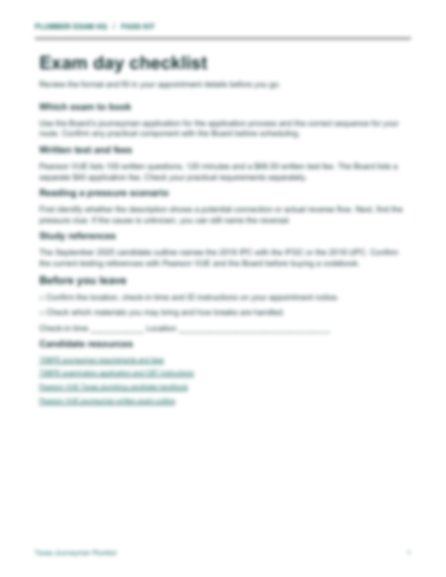
Exam day checklist
Review the format and fill in your appointment details before you go.
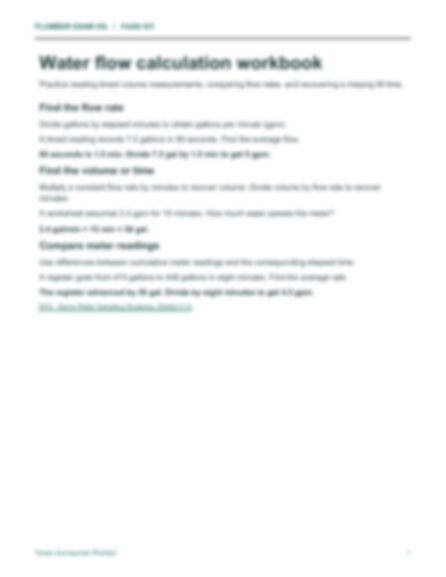
Water flow calculation workbook
Practice reading timed volume measurements, comparing flow rates, and recovering a missing fill time.
A drawing specifies a slope of one-quarter inch per foot over a horizontal run of 32 feet. If the upstream invert is fixed, how much lower is the downstream invert?
Multiply 32 feet by 0.25 inch per foot to get 8 inches of fall. Subtract the fall when working downstream from a known elevation. The slope here is supplied by the drawing. Selecting a minimum permitted slope for a particular pipe is a separate code-lookup question.
Further reading: Water system math review, tank capacity
421 questions in the complete bank. The public preview includes 25 questions across the study topics.
Texas journeyman plumber math and water-supply practice
Distinguish registered and licensed roles using the Board’s definitions.
6 questionsRead scenarios on employment, advertising, inspections and insurance.
6 questionsIdentify when a specialty endorsement or a current credential is required.
6 questionsWork from a steady rate, a total and elapsed time. Check the units in each answer.
18 questionsInterpret written water-supply scenarios and distinguish pressure mechanisms, safeguards and surveys.
12 questionsUse inside dimensions and water depth to find storage volume in cubic feet or gallons.
18 questionsRead gravity drainage plans and explain how pressure changes or disuse affect a trap.
9 questionsCompare storage and demand heaters, read safety-device labels and match equipment to the hot-water demand.
12 questionsCheck trap weirs, vent takeoffs and wet-vent sizing against the dated UPC study track.
11 questionsReview fixture supports, access panels, overflow paths, shower outlets, urinals, laundry receptors and fixture-count worksheets.
23 questionsRead static water levels, pressure references and backflow assembly diagrams.
10 questionsIdentify drainage, venting, service and fixture components on residential plans.
12 questionsRead fuel-fired appliance records and distinguish combustion venting from potable-water components.
8 questionsCompare cleanout details, branch transitions, sewage backflow elevations and ejector pump curves.
10 questionsIdentify riser transitions, gas quality definitions and drip provisions on the 2018 UPC study track.
9 questionsRead original fixture, trap arm and fitting decisions against the 2018 UPC, Chapter 10.
11 questionsReview trap seal protection, floor drain records and industrial interceptor plans against the 2018 UPC.
13 questionsCheck drainage piping, fitting suitability and material markings under 2018 UPC Chapter 7.
6 questionsReview continuous-flow loads, branch intervals and fixture connections under 2018 UPC Chapter 7.
8 questionsPractice 2018 upc water valves and tanks with original drawing and submittal cases based on Chapter 6.
12 questionsCheck 2018 upc water supply sizing review decisions using the published requirements in Chapter 6.
9 questionsPractice water heater protection and indirect exchangers with original drawing and submittal cases based on Chapter 5.
10 questionsCheck water heater placement and replacement decisions using the published requirements in Chapter 5.
10 questionsPractice water service installation and tests with original drawing and submittal cases based on Chapter 6.
11 questionsCheck water distribution review and design decisions using the published requirements in Chapter 6.
13 questionsPractice 2018 upc drainage joint and fitting decisions with original drawing and submittal cases based on Chapter 7.
6 questionsCheck 2018 upc drainage cleanout access decisions using the published requirements in Chapter 7.
6 questionsPractice 2018 upc pumped drainage and backwater protection with original drawing and submittal cases based on Chapter 7.
7 questionsCheck 2018 upc building sewer review decisions using the published requirements in Chapter 7.
5 questionsPractice 2018 upc fixture submittal checks with original drawing and submittal cases based on Chapter 4.
6 questionsCheck 2018 upc flushing, drinking and supply fittings decisions using the published requirements in Chapter 4.
6 questionsPractice 2018 upc shower receptor and layout review with original drawing and submittal cases based on Chapter 4.
5 questionsCheck 2018 upc floor drainage and sink connections decisions using the published requirements in Chapter 4.
7 questionsPractice 2018 upc vent sizing and exceptions with original drawing and submittal cases based on Chapter 9.
7 questionsCheck 2018 upc stack and terminal layout decisions using the published requirements in Chapter 9.
7 questionsPractice 2018 upc access and system terminology with original drawing and submittal cases based on Chapter 2.
6 questionsCheck 2018 upc building drainage terminology decisions using the published requirements in Chapter 2.
6 questionsPractice 2018 upc specialty and drawing terms with original drawing and submittal cases based on Chapter 2.
6 questionsCheck 2018 upc fixture and measurement terms decisions using the published requirements in Chapter 2.
6 questionsApply Texas Occupations Code provisions to original contractor scope and permit situations.
12 questionsPractice 2018 upc special vent arrangements with original drawing and submittal cases based on Chapter 9.
3 questionsCheck 2018 upc circuit and engineered vents decisions using the published requirements in Chapter 9.
4 questionsPractice 2018 upc fuel gas scope and inspections with original drawing and submittal cases based on Chapter 12.
7 questionsCheck 2018 upc fuel supply records and capacity decisions using the published requirements in Chapter 12.
7 questionsPractice 2018 upc indirect waste connections with original drawing and submittal cases based on Chapter 8.
8 questionsCheck 2018 upc indirect receptors and appliance drainage decisions using the published requirements in Chapter 8.
6 questionsPractice 2018 upc backflow assembly design review with original drawing and submittal cases based on Chapter 6.
8 questionsCheck 2018 upc specialty supply protection decisions using the published requirements in Chapter 6.
7 questionsThe Texas State Board of Plumbing Examiners calls the written portion the computer-based test. Pearson VUE administers it. The practice here focuses on the written material.
Use the Board’s journeyman application for the application process and the correct sequence for your route. Confirm any practical component with the Board before scheduling.
Pearson VUE lists 100 written questions, 120 minutes and a $68.50 written test fee. The Board lists a separate $40 application fee. Check your practical requirements separately.
First identify whether the description shows a potential connection or actual reverse flow. Next, find the pressure clue. If the cause is unknown, you can still name the reversal.
The September 2025 candidate outline names the 2018 IPC with the IFGC or the 2018 UPC. Confirm the current testing references with Pearson VUE and the Board before buying a codebook.